Articles > Nadar History Misconceptions > The Upper Cloth Revolt: Colonial Ethnocentrism and the Historical Reality of Travancore's Dress Norms.
The Upper Cloth Revolt: Colonial Ethnocentrism and the Historical Reality of Travancore's Dress Norms.
Nadar History Misconceptions
Featured
First published: July 7, 2026
|
Last updated: July 9, 2026
Introduction
The historiography of the discrimination faced by the Nadar community during the 19th century is largely drawn from the works of colonial-era writers—who either had an insular perspective or lacked the methodological expertise of modern-day historians. The Upper Cloth Revolt, or Shanar Revolt, a complex issue concerning dress norms in Southern Travancore, is often misinterpreted by researchers. This essay aims to clarify the many misconceptions surrounding the Shanar revolt of the 19th century in light of modern research and findings. The current essay is based on the research of Mr. S. Ramachandran, Dr. J. Devika, and Dr. Manu S. Pillai.
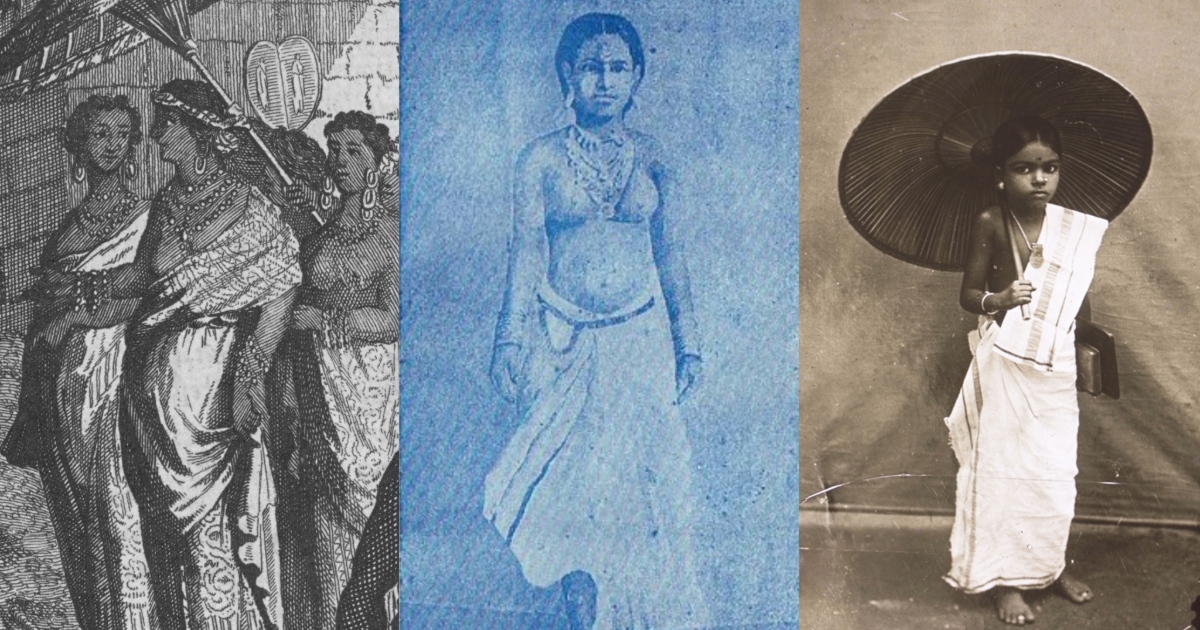
Dress norms among upper-class women in pre-modern Kerala.
Sartorial conventions of Ancient Kerala
The sartorial conventions of ancient Kerala were distinctive and differed markedly from those of Western societies. Many European writers were unable to comprehend the culture of ancient Kerala, consequently producing accounts shaped by ethnocentric assumptions. Prior to the twentieth century, the majority of both men and women in Kerala did not wear clothing above the waist. This practice was widely misinterpreted by colonial-era chroniclers, some of whom even inaccurately posited that the exposure of the female upper body was a submissive obligation intended for the gratification of the Brahmin elites. In contrast, several contemporary accounts indicate that the exposure of the upper body in Kerala had nothing to do with a woman’s modesty.
Early visitors to South India described local women moving about in public with little concern for covering the upper body, suggesting that such exposure did not carry the same connotations of shame as it did in many Western societies. Marco Polo, for instance, described the people of South India he encountered as wearing minimal clothing and interpreted their sexual morality through his own cultural assumptions, revealing a distinctly foreign and ethnocentric perspective. This colonialist framing, which pathologized native habits as obscene, underscored a fundamental inability to comprehend non-Western societal structures.
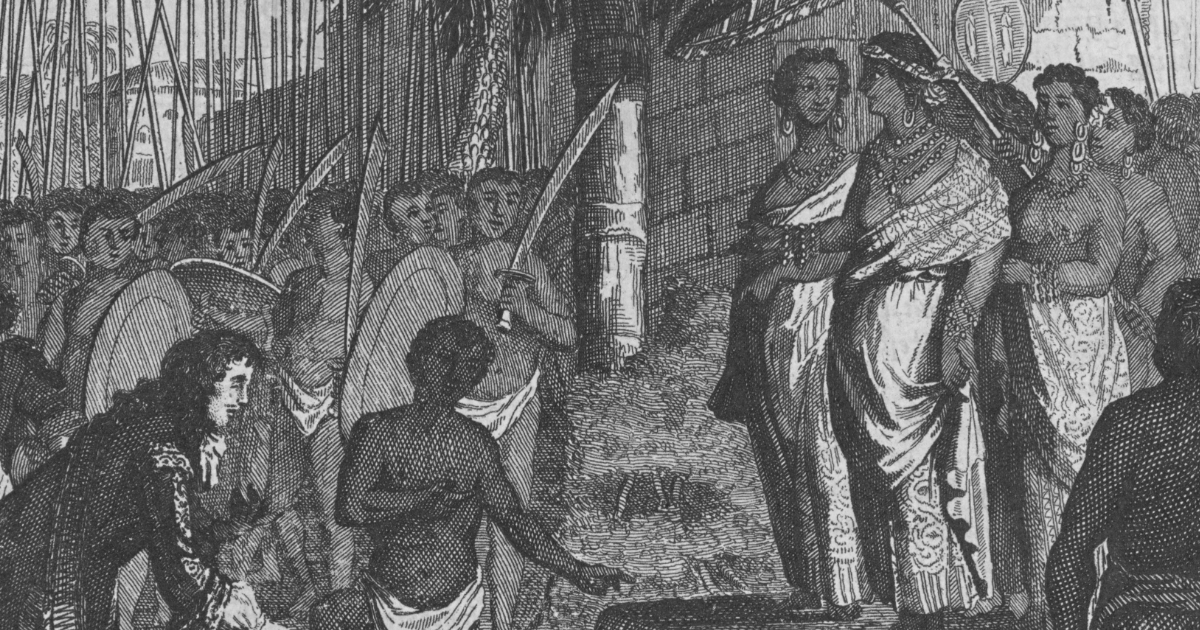
17th-century engraving depicting the meeting between Umayamma Rani, the queen regent of Venad, and Johan Nieuhof.
A seventeenth-century engraving depicting Umayamma Rani, the queen regent of Venad, and the Dutch traveler Johan Nieuhof portrays her with an uncovered upper body, reflecting the dress norms of the period. Later, the anthropologist Fred Fawcett, drawing on fieldwork he conducted in Malabar in the late nineteenth century, observed that there was a widespread belief that respectable women should not cover their breasts.
Early visitors to South India described local women moving about in public with little concern for covering the upper body, suggesting that such exposure did not carry the same connotations of shame as it did in many Western societies. A seventeenth-century engraving depicting Umayamma Rani, the queen regent of Venad, and the Dutch traveler Johan Nieuhof portrays her with an uncovered upper body, reflecting the dress norms of the period.
Similarly, nineteenth-century observers such as William Logan noted that the regional conception of women's modesty functioned as a direct inversion of European sensibilities, a phenomenon further evidenced by the fact that public breastfeeding carried no social stigma in pre-modern Kerala. This cultural ethos persisted into the early twentieth century, as noted in the memoirs of K.P.S. Menon, an Indian diplomat from Kerala, who recalled that during his youth, the adoption of a blouse was pejoratively dismissed as veshamkettal—an ostentatious or performative display of immodesty.
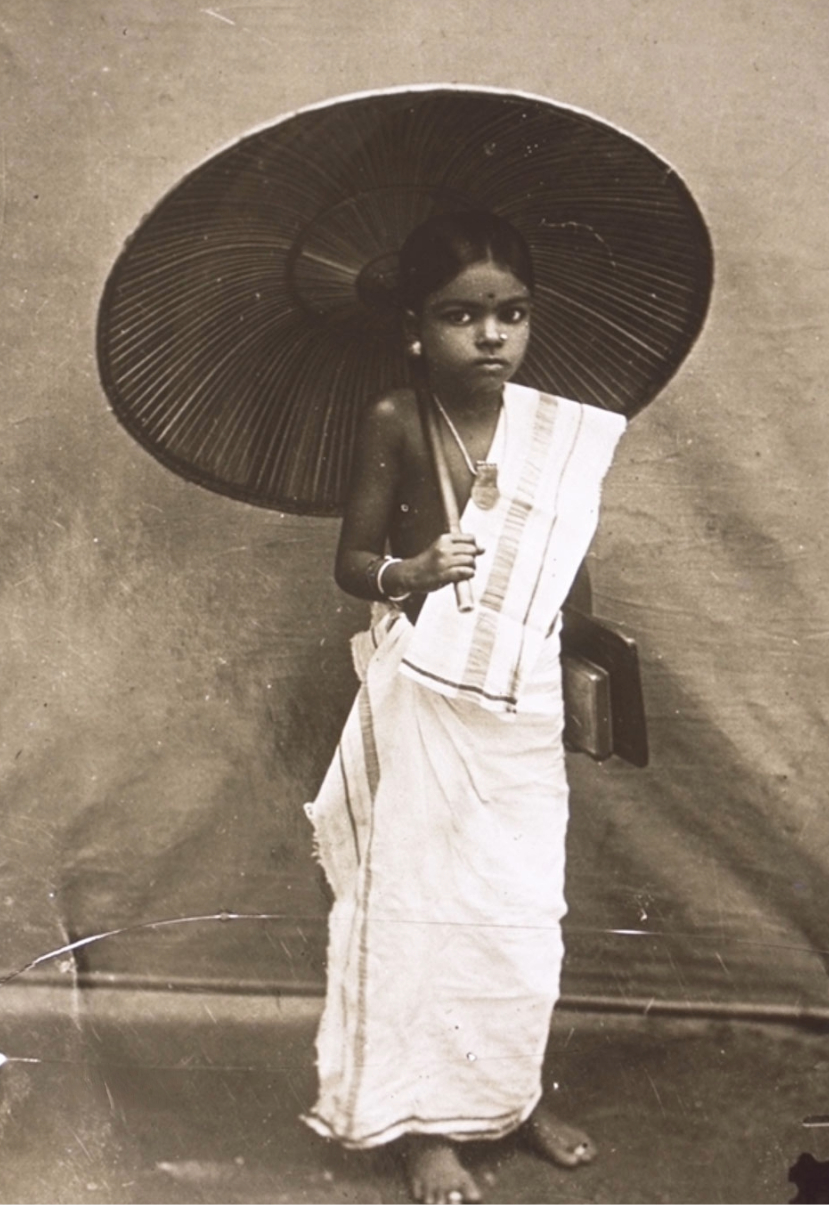
An upper-class girl from pre-modern Kerala wearing the traditional upper cloth.
Certain wealthy Kerala women belonging to higher castes wore the upper cloth, a garment resembling a shawl, as a marker of status rather than as a requirement of modesty. The use of the upper cloth was not mandatory even among affluent Kerala women. However, women and men belonging to castes other than the Namboothiris were expected to remove their upper cloths in the presence of members of castes superior to their own. More specifically, Namboothiri Brahmins, who occupied the highest position in the Kerala caste hierarchy, were required to bare their chests before deities, while members of all castes below the Namboothiris were expected to do the same in the presence of castes above them. Lower castes, associated with labor, were prohibited from wearing the upper cloth. This practice functioned as a gesture of respect to higher communities rather than an expression of sexual submissiveness. Historian Manu S. Pillai argues that the story of Nangeli—who is said to have cut off her breasts in protest—is most likely fictional and does not align with the historical evidence.
Prior to the twentieth century, the majority of both men and women in Kerala did not wear clothing above the waist. 19th-century observers such as William Logan noted that the regional conception of women's modesty functioned as a direct inversion of European sensibilities, a phenomenon further evidenced by the fact that public breastfeeding carried no social stigma in pre-modern Kerala. Certain wealthy Kerala women belonging to higher castes wore the upper cloth, a garment resembling a shawl, as a marker of status rather than as a requirement of modesty. The use of the upper cloth was not mandatory even among affluent Kerala women. Lower castes, associated with labor, were prohibited from wearing the upper cloth. Historian Manu S. Pillai argues that the story of Nangeli—who is said to have cut off her breasts in protest—is most likely fictional and does not align with the historical evidence.
The Upper Cloth Revolt and S. Ramachandran's Interpretation
As the upper cloth served as a marker of status in Southern Travancore, the state systematically denied the Nadar palmyra laborers, who harvested the palmyra trees, the right to cover their upper bodies. Yet this restriction wasn't entirely uniform. The Nilaimaikkarar women of Southern Travancore, who formed the landed aristocracy within the broader Nadar community, held the privilege of wearing the upper cloth. By contrast, Nadar women of all classes in the neighboring Tirunelveli region freely wore the upper cloth. Kathleen Gough, an anthropologist who studied the caste system of Kerala, placed the Ezhavas above the Kaniyars and the artisan castes (such as blacksmiths and carpenters) that ranked below them. Like the Nadar palmyra laborers, the Ezhavas tended coconut palms and were generally regarded as belonging to a comparable social stratum during the nineteenth century. It is therefore safe to assume that castes such as the Kaniyars—who are today classified as Backward Castes—were also prohibited from wearing the upper cloth.
The broader demand by Nadar laborers of Southern Travancore to wear the upper cloth contributed to the disturbances known as the Upper Cloth Revolt or Shanar Revolt [note 1]. Colonial-era chroniclers frequently misread this complex social landscape, portraying the controversy as a civilizing mission in which British Christian missionaries taught native women Western notions of decency and respectability.
As the upper cloth served as a marker of status in Southern Travancore, the state systematically denied the Nadar palmyra laborers, who harvested the palmyra trees, the right to cover their upper bodies. Yet this restriction wasn't entirely uniform. The Nilamaikkarar women of Southern Travancore, who formed the landed aristocracy within the broader Nadar community, held the privilege of wearing the upper cloth. By contrast, Nadar women of all classes in the neighboring Tirunelveli region freely wore the upper cloth. Based on Gough's account of the Kerala caste hierarchy, it is safe to assume that castes ranked below the Ezhavas, such as the Kaniyars and Kollars—who are today classified as Backward Castes—were also prohibited from wearing the upper cloth.
A collective petition dated 7 February 1859, submitted by six LMS missionaries in South Travancore to the Raja of Travancore through Resident General Cullen and preserved in the House of Commons parliamentary papers relating to the Travancore disturbances, states that a significant section of the Nadar community, including elite sections such as the Nilamaikkarars and those who seasonally migrated to Tirunelveli and returned to Travancore, had long worn the upper cloth. The petition further indicates that certain low-level officials exploited Queen Victoria's proclamation of 1858, which declared that the British government would not intervene in Indian cultural practices, to launch attacks on Christian Nadar men and women.
Building on this, Mr. S. Ramachandran suggests that the widespread participation of the Nadar community in the Upper Cloth Revolt is best understood as an attempt by most Nadars to adopt a custom that already existed within their own community, rather than as the acceptance of a new practice introduced by British Christian missionaries. He further argues that, following the Queen's Proclamation of 1858, sections of the higher Sudra communities relied on its principle of non-interference in indigenous customs to resist what they perceived as a violation of established caste privileges. From this perspective, the dispute arose from the intersection of two competing cultural traditions: one that regarded the wearing of the upper cloth as an established communal custom and another that construed the same practice as a transgression against their feudal authority.
Mr. Ramachandran further supports his inference by citing lines from ancient Nadar villuppattu ballads—which were publicly performed—that mock the customs of higher Sudra castes. He argues that they reflect a longstanding cultural rivalry between the two groups. Nevertheless, this evidence indicates that the Nadars were simply trying to maintain a cultural practice native to their own community, rather than adopting a code of conduct introduced by British Christian missionaries.
Based on evidence from the House of Commons, Mr. S. Ramachandran suggests that the widespread participation of the Nadar community in the Upper Cloth Revolt is best understood as an attempt by most Nadars to adopt a custom that already existed within their own community, rather than as the acceptance of a new practice introduced by British Christian missionaries.
Social Status of the Nadars Before the Colonial Era
Two 17th-century inscriptions from Veeravanallur were recently identified by Dr. T. T. Thavasimuthu Maran and later documented by Dr. S. Thamarai Pandian of the International Institute of Tamil Studies. Veeravanallur is located in the Thovalai Taluk, which formed part of Southern Travancore and now lies in the Kanniyakumari district, Tamil Nadu. These inscriptions show that Rama Nachiyar, a Shanar woman, was both economically well placed and held in high esteem by a member of a community then regarded as upper caste.
The inscriptions do not associate Rama Nachiyar with the title Nadan, which is consistently used in inscriptions referring to members of the elite sections of the Nadar community. Her omission from this titled category indicates that she belonged to a non-elite section of the Nadar community. Yet she possessed immense wealth, demonstrating that prosperous non-elite Nadars existed in the seventeenth century and challenging the notion that the Nadar community was traditionally impoverished.
Long before the colonial period, the ancestors of the Nadars, known as the Sanrors, occupied a prominent place in Tamil history. Ancient records associate the Sanrors with royal lineage, military service, and important roles in governance and warfare. Although their social and political status changed over time, these sources continue to affirm their former elevated status.
Two 17th-century inscriptions from Veervanallur, Kanniyakumari district, show that Rama Nachiyar, a Shanar woman, was both economically well placed and held in high esteem by a member of a community then regarded as upper caste. Ancient records likewise associate the Sanrors, the ancestors of the Nadars, with royal lineage, military service, and important roles in governance and warfare. Although their social and political status changed over time, these sources continue to affirm their former elevated status.
Conclusion
The essay highlights the major differences between the accounts written by colonial-era chroniclers and the interpretations of modern-day historians. Due to ethnocentric perspectives, colonial-era chroniclers misinterpreted local dress norms—that were widely regarded as customary by the local population—and produced historically flawed accounts. As per various accounts, the baring of the breast was not regarded as immodest in pre-modern Kerala. These discrepancies clearly reveal that it is vital to understand the perspective of the community that is being researched, and they further identify the shortcomings of historical accounts written by colonial-era writers.
The evidence presented in the essay indicates that, during the disturbances of the Upper Cloth Revolt, the Nadar laborers were trying to maintain a tradition that was already a part of their community—a move that was clearly not motivated by British Christian missionaries. As per Mr. Ramachandran's interpretation, this triggered a cultural clash between two different groups—each believing that they were restoring a traditional norm. Recent inscriptional discoveries reveal that the non-elite Nadars were not traditionally impoverished.
Notes
- The terms Sanrar, Sanravar and Sanar are variants of the term Sanror. This is because of a common linguistic feature in Tamil. For instance, the word Kaṉṟu (meaning "calf") and its variant Kaṇṇu are essentially the same word with different pronunciations. The Nadars today were previously known as Sanars or Shanars. This interpretation is further supported by the 17th-century Karumapuram copper plate, which refers to the Sanrors as Saana Kulam, meaning "Saana clan" in Tamil, and describes a member of the clan as Saana Kula Dheeran, which loosely translates to "valiant hero of the Saana clan." The term Saana is the adjectival form of Sanar in Tamil and thus corroborates that the Sanrors are, in fact, the Sanars (Nadars)—as Saana serves as an epithet specifically referring to the Sanrors.
See Also
- Unravelling the Historical Misconceptions Surrounding the Nadar Community: The Actual Social Standing of the 19th-Century Nadars.
- Uraan Nilaimaikkarars: A Historical and Sociocultural Analysis of an Aristocratic Nadar Subsect.
- A Wealthy 17th-Century Shanar Woman Who Left a Legacy Through Her Charitable Donations.
- From oblivion to light: Reconstructing Nadar community's history through recently discovered ancient documents.
- Connecting the Dots: Understanding the Relationship Between the Noble Sanrors and the Nadar Community.
References
- S. Ramachandran and A. Ganesan. Thōḷcīlaik Kalakam: Terinda Poikaḷ Teriyāta Uṇmaikaḷ. South Indian Social History Research Institute (SISHRI), 2011.
- Devika, J. "The Aesthetic Woman: Re-forming Female Bodies and Minds in Early Twentieth-Century Keralam." Modern Asian Studies, vol. 39, no. 2, Cambridge University Press, 2005, pp. 461–487.
- Pillai, Manu S. "The Woman Who Cut Off Her Breasts." The Hindu, 19 Feb. 2017.
- Gautam, Swati. "The Breast Tax That Wasn't." The Telegraph, 14 Jan. 2021.
- Gough, Kathleen. "Nayar: Central Kerala." Matrilineal Kinship, edited by David M. Schneider and Kathleen Gough, University of California Press, 1961, p. 312.
- Hardgrave, Robert L., Jr. The Nadars of Tamilnad. University of California Press, 1969.
- "Vīravanallūril 300 āṇṭukaḷ paḻamaiyāṉa pāṇṭiyar kāla kalveṭṭukaḷ kaṇṭupiṭippu." Hindu Tamil Thisai, 26 December 2023.
- "300 āṇṭukaḷ paḻamaiyāṉa piṟkāla pāṇṭiyar kalveṭṭukaḷ kaṇṭupiṭippu." Hindu Tamil Thisai, 30 December 2023.